
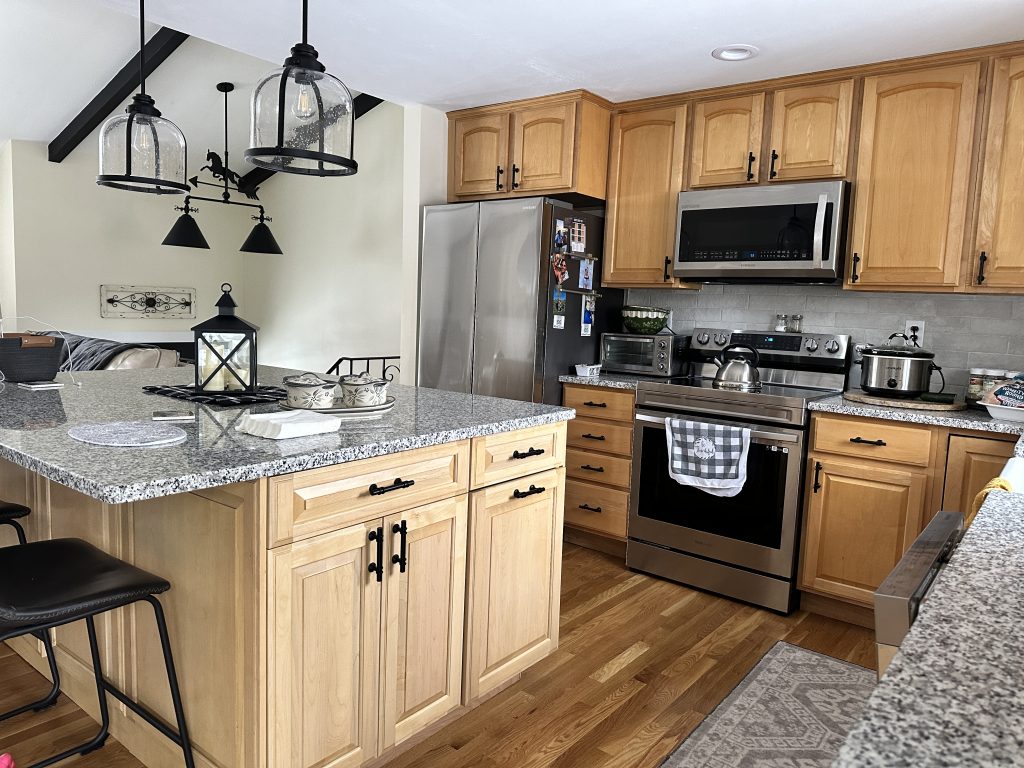
Your kitchen is calling for an upgrade—but before you start picking out cabinet styles and countertop samples, there’s one question that needs answering: how much will this actually cost?
Kitchen remodels in Massachusetts typically range from $35,000 to $100,000 or more, with the final number depending on decisions you’ll make throughout the process. The good news is that most of these decisions are within your control. Understanding what drives costs up (and what keeps them reasonable) puts you in the driver’s seat from day one.
Here’s what actually affects your kitchen remodel budget in Worcester County, Metrowest, and the surrounding areas.
1. Cabinetry: The Single Largest Investment
Cabinets consistently account for 25% to 40% of a kitchen remodel budget—making them the biggest line item by far. The range in pricing comes down to three main options.
Stock cabinets come in pre-made sizes and limited finishes. They’re the most affordable choice at roughly $100 to $300 per linear foot, and they arrive quickly since there’s no custom manufacturing involved. The tradeoff is limited flexibility—your layout needs to work with their standard dimensions.
Semi-custom cabinets offer a middle ground. You get more choices in sizes, styles, and interior configurations while staying in the $300 to $700 per linear foot range. For most homeowners in Massachusetts looking for quality without extreme pricing, semi-custom cabinets hit the sweet spot.
Custom cabinets are built specifically for your space with unlimited design options. Expect $700 to $1,500 or more per linear foot. These make sense when you have unusual dimensions, want to match historic architectural details, or simply want something no one else has.
Beyond the cabinet type itself, the door style matters too. Simple shaker doors cost less than intricate raised-panel designs. And the interior features—soft-close hinges, pull-out shelves, built-in organizers—add up quickly, so prioritize the upgrades that will genuinely improve your daily routine.
2. Countertops: Where Form Meets Function
Countertops typically represent about 10% to 11% of your total budget, though premium materials can push that higher. Your options span a wide range.
Budget-friendly options like laminate run $20 to $40 per square foot installed and have come a long way in terms of appearance. Modern laminate can mimic stone patterns convincingly, though it won’t have the same durability or resale appeal as natural materials.
Mid-range choices include granite ($50 to $80 per square foot) and quartz ($60 to $100 per square foot). Quartz has become especially popular among Massachusetts homeowners because it’s non-porous, requires no sealing, and offers consistent patterns throughout the slab.
High-end materials like marble, quartzite, or specialty stones can run $100 to $200 or more per square foot. These make a statement but require more maintenance and careful consideration of your household’s cooking habits.
The countertop material you choose also affects installation complexity. Heavier materials like granite and quartzite require reinforced cabinetry, which can add to base cabinet costs.
3. Appliances: From Functional to Professional-Grade
Appliances account for roughly 17% of a typical kitchen remodel budget, but this category has perhaps the widest pricing range of any component. A complete appliance package might cost $4,000 for reliable mid-range options or exceed $25,000 for professional-grade equipment.
Consider what actually matches your cooking habits. If you rarely use your oven, a commercial-style range probably isn’t worth the investment. On the other hand, if you cook frequently for large gatherings, upgrading to a larger refrigerator or double ovens might genuinely improve your life.
Energy efficiency matters too—both for utility savings and for qualifying for rebates. Massachusetts offers incentives through Mass Save for certain Energy Star appliances, which can offset some of the upfront cost.
One practical tip: if you’re replacing a standard-depth refrigerator with a counter-depth model (or vice versa), the surrounding cabinetry may need adjustment. Factor that into your planning.
4. Layout Changes: Where Costs Can Multiply Quickly
Keeping your existing layout is one of the most effective ways to control costs. The moment you start moving things around—especially plumbing and electrical—the budget expands significantly.
Moving a sink means rerouting water supply and drain lines, which typically adds $1,000 to $3,000 or more depending on how far it needs to travel and what’s in the way.
Relocating gas lines for a stove or cooktop runs $375 to $750 on average, though complex runs cost more. This work requires licensed professionals and proper permitting.
Adding or moving electrical outlets might seem minor, but rewiring for a kitchen island, relocating circuits, or upgrading to handle new appliances adds up. Many older Massachusetts homes also need electrical panel upgrades to support modern kitchen demands.
Removing walls to create an open-concept layout is one of the biggest cost drivers. If the wall is load-bearing, you’ll need structural engineering and beam installation, potentially adding $5,000 to $15,000 or more to the project.
This doesn’t mean layout changes aren’t worth it—sometimes they’re exactly what transforms a cramped, inefficient kitchen into one that works beautifully. Just go in with realistic expectations about what that transformation requires.
5. Labor Costs: The Massachusetts Factor
Labor typically represents 30% to 40% of a kitchen remodel budget in Massachusetts. This includes demolition, carpentry, plumbing, electrical work, tile setting, painting, and finish carpentry. Skilled tradespeople in the Worcester County area command competitive rates, reflecting both the cost of living and the quality of workmanship available.
The design-build approach—where one team handles design through construction—can actually reduce overall labor costs by eliminating the coordination gaps that occur when multiple unconnected contractors work on the same project. When everyone is working from the same plan with clear communication, there’s less rework and fewer delays.
Timeline affects labor costs too. Rush jobs cost more. Planning your remodel during shoulder seasons (late fall or early winter) might offer slightly better scheduling flexibility, though experienced contractors stay busy year-round.
6. The Age and Condition of Your Home
Massachusetts has no shortage of older homes, and their character comes with some practical considerations during a kitchen remodel.
Outdated electrical systems in homes from the 1950s through 1980s often can’t support modern kitchen loads. Upgrading to a higher-capacity panel or adding dedicated circuits for appliances is common—and necessary for safety.
Older plumbing may need replacement, especially if you encounter galvanized pipes or outdated configurations. What starts as a simple sink replacement sometimes reveals corroded supply lines that should be addressed while the walls are open.
Lead paint and asbestos can be present in homes built before 1978. If renovation work will disturb these materials, proper abatement procedures are required, adding both time and cost to the project.
Structural surprises like water damage, wood rot, or inadequate framing sometimes only become apparent once demolition begins. This is why experienced contractors recommend a contingency budget of 10% to 15% for unexpected discoveries.
The silver lining: addressing these issues during a remodel prevents bigger problems down the road and can actually be more cost-effective than tackling them separately.
7. Project Timeline and Planning
How long a kitchen remodel takes directly affects its cost—and proper planning on the front end saves money throughout the process.
Timeline expectations: A moderate kitchen remodel typically takes 6 to 8 weeks of active construction, but the full process from initial planning to final touches often spans 3 to 6 months. That includes design development, material selections, ordering (cabinets can take 4 to 8 weeks to arrive), permitting, and the build itself.
Why planning matters financially: Rushed decisions lead to change orders, and change orders are expensive. When you select your countertops before the cabinets are installed, you avoid delays. When your appliance specifications are confirmed before the rough electrical, outlets end up in the right places the first time. Pre-planning with detailed measurements and material selections eliminates the costly back-and-forth that happens when projects are figured out on the fly.
Living arrangements: If your kitchen will be out of commission for two months, factor in the cost of eating out more often or setting up a temporary kitchen space. These aren’t line items in your contractor’s estimate, but they’re real costs that affect your overall budget.
Modern tools like LiDAR scanning help speed up accurate measurements and layout planning, reducing the guesswork that used to extend project timelines. The more precision in the planning phase, the fewer surprises during construction.
9. Permits and Code Compliance
Building permits in Massachusetts typically run $500 to $1,500 for a kitchen renovation, with the exact cost depending on your municipality and project scope. Electrical and plumbing work usually requires separate permits and inspections.
While permits add cost, they exist to protect you. Permitted work is inspected for safety and code compliance, and it’s properly documented for future home sales. Unpermitted work can create headaches when you sell—and potentially safety hazards in the meantime.
A reputable contractor handles permit applications and coordinates inspections as part of their service. This is one of those behind-the-scenes tasks that’s easy to overlook but essential to getting done right.
10. Finish Level and Design Complexity
The overall “finish level” of your kitchen—the quality tier of materials and details throughout—has a cumulative effect on cost. This includes everything from cabinet hardware and faucet styles to backsplash materials and light fixtures.
A simple subway tile backsplash costs far less than hand-cut mosaic stone. Brushed nickel hardware is more affordable than custom brass. Basic recessed lighting is simpler than a layered lighting plan with pendants, under-cabinet LEDs, and dimmers.
None of these individual choices is necessarily right or wrong—it’s about being intentional. Decide where elevated finishes matter most to you and where standard options work just fine. Many homeowners invest in high-quality cabinets and countertops (the elements they’ll touch and see daily for years) while being more conservative on items that are easy to upgrade later.
What This Means for Your Budget
Kitchen remodels in Massachusetts generally fall into these ranges:
A modest refresh that keeps the existing layout and focuses on surface updates—new cabinet doors, countertops, and appliances—might come in around $25,000 to $40,000.
A comprehensive remodel with new cabinetry, upgraded finishes, and some layout optimization typically runs $50,000 to $80,000.
A full transformation that involves structural changes, high-end materials, and extensive customization can exceed $100,000.
Within each range, your specific choices determine where you land. The key is understanding those choices before you’re in the middle of the project.
Getting an Accurate Picture for Your Kitchen
Every kitchen is different—in size, condition, layout, and what it needs to become. Generic cost calculators can give you a starting point, but they can’t account for the specifics of your space or the market realities in Worcester County and Metrowest.
The clearest path to an accurate budget is a conversation with someone who can assess your actual kitchen, understand what you’re hoping to accomplish, and give you real numbers based on real conditions.
Ready to get started? Schedule a consultation to discuss your kitchen project, or use our Get A Quote button for a faster response. We’ll walk through your space, talk through your priorities, and give you a clear picture of what your remodel will involve.
RenoVista Construction is a design-build remodeling firm serving Worcester County, Metrowest, and Norfolk County. From initial design through final walkthrough, one team handles your entire project—no gaps, no handoffs, no surprises.